
Unlocking the Power of RAG for Smarter Text Generation
Do you find it frustrating when a language model like ChatGPT provides generic responses that miss the mark? If only you could guide it with specific information and get truly meaningful results. This is where Retrieval-Augmented Generation (RAG) excels.
RAG is a powerful framework in Natural Language Processing (NLP) that blends generative AI with external knowledge to deliver more contextually relevant and reliable outputs.
What is RAG?
How RAG Works: Step-by-Step
RAG, short for Retrieval-Augmented Generation, represents a significant leap forward in AI text generation. Unlike traditional models that rely solely on pre-existing training data, RAG dynamically pulls in information from defined data sources, such as documents, databases, or APIs. This enables it to craft responses grounded in real-world knowledge, making it highly suitable for applications requiring up-to-date, accurate information.
Breaking down the acronym helps explain its power:
- Retrieval: Accesses information from predefined data sources, enriching the content generation process.
- Augmented: Enhances the language model’s understanding by incorporating this context into responses.
- Generation: Synthesizes the retrieved information and user input to produce high-quality, context-aware text.
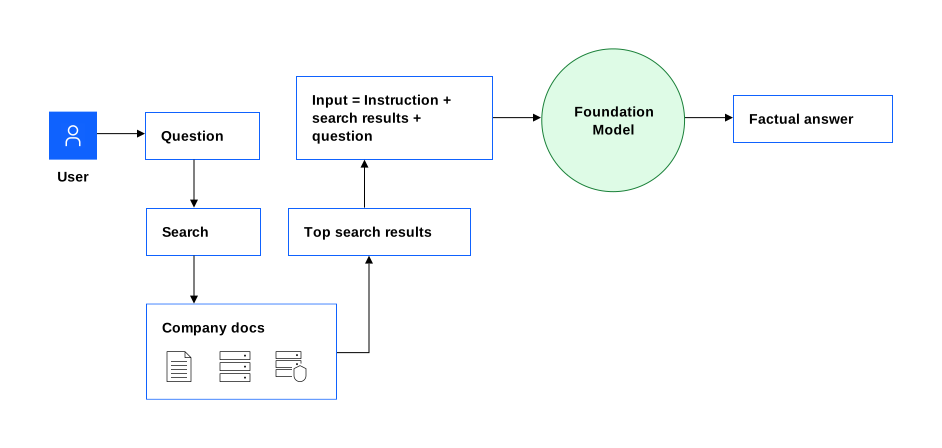
RAG operates through a series of structured steps:
- Data Organization
Think of this step as creating a virtual library, where every document, piece of metadata, or external knowledge source is indexed for easy access. RAG uses advanced indexing methods such as lexical indexing (exact word matches) or vector indexing (capturing semantic meaning) to organise data efficiently, this is then stored in (usually vector) database such as Milvus.
- Input Query Processing
The model first refines the user’s question to ensure it aligns well with the indexed data. By breaking down the query into searchable elements, RAG maximises the likelihood of retrieving the most relevant content.
- Searching and Ranking
This is where RAG dives into its database to locate the best matches for the refined query. Like a high-performance search engine, it ranks results based on relevance, ensuring only the most pertinent information is passed to the generation stage.
- Prompt Augmentation
The identified data is then re-integrated into the original prompt, augmenting it with specific context. This process enriches the language model’s understanding, allowing it to produce responses that are not just informed, but also nuanced.
- Response Generation
Finally, the AI synthesizes all the gathered information into a coherent, contextually grounded response. The result? A reply that goes beyond the standard, generic output and resonates with relevance and accuracy.
Why use RAG?
The true strength of RAG lies in its ability to merge the creativity of generative AI with the precision of knowledge retrieval. Some of the standout benefits include:
•Cost-Effectiveness: While training a new language model can require months and significant computational resources, RAG can operate efficiently using existing hardware setups.
•Real-Time Adaptability: RAG can quickly incorporate new information into its database, ensuring that responses are always up-to-date without the need for time-consuming retraining.
•Enhanced Reliability: Because it draws on defined grounded data sources, RAG is less prone to generating hallucinated or inaccurate content, making it a trustworthy tool for enterprise applications.
Key Challenges when Using RAG
Despite its promise, RAG isn’t without its challenges. The quality of its outputs depends heavily on the richness of the data sources and the clarity of the initial prompt. Additionally, because RAG builds on existing data, it can sometimes struggle with creative tasks that require more abstraction or originality.
How RAG Stacks Up Against Other Techniques
One common point of confusion is distinguishing RAG from semantic search. While both aim to improve response quality, they serve different purposes. Semantic search focuses on understanding the meaning behind a query to retrieve the best matches, making it a powerful tool for search engines. RAG, on the other hand, goes a step further by integrating retrieved content into the generation process, creating text that’s not only relevant but also contextually enriched.
Examples of and Use Cases For RAG
Retrieval-Augmented Generation (RAG) is rapidly gaining traction across various industries due to its ability to combine real-time data retrieval with natural language generation, producing responses that are both contextually relevant and grounded in current information. Here are some prominent examples and use cases that illustrate the impact of RAG in practice:
1. Enhanced Conversational AI: ChatGPT and Perplexity AI
RAG underpins the advanced capabilities of conversational agents like ChatGPT when augmented with plugins or APIs that enable dynamic access to external data sources. By using retrieval plugins, ChatGPT can query proprietary databases or even online sources to generate real-time responses tailored to specific queries. This capability significantly boosts its effectiveness in areas like customer support, technical troubleshooting, and real-time content recommendations.
Similarly, Perplexity AI leverages RAG to answer complex questions by seamlessly combining retrieved data with generative text, making it suitable for detailed Q&A scenarios and use cases that require integrating multiple information sources.
2. Industry-Specific Implementations: Bloomberg and Grammarly
RAG is also being adopted in industry-specific applications to enhance accuracy and relevance.
Bloomberg, for instance, integrates RAG into its financial platforms to generate comprehensive reports, summarizing the latest market trends and integrating real-time financial data. This helps analysts and clients make informed decisions quickly, without manually sifting through voluminous datasets.
Grammarly uses a similar approach for content refinement, dynamically pulling in references to improve its suggestions and ensuring the generated text aligns with the latest writing conventions and user context.
3. Healthcare and Medical Consultation
In healthcare, RAG is being used for clinical decision support, where it retrieves relevant medical studies, patient records, and treatment guidelines to provide contextually accurate advice. This enables healthcare professionals to make informed decisions based on the most current medical knowledge. RAG’s utility extends to clinical trial design, where it can optimize trials by analyzing vast amounts of research data and identifying suitable patient cohorts.
4. Financial Planning and Management
In the financial sector, RAG enhances advisory services by integrating up-to-date regulations, market trends, and institutional policies into its responses. This approach not only improves the quality of financial advice but also ensures compliance and relevance in a constantly evolving regulatory landscape.
5. Content Creation and Summarization
RAG’s capability to dynamically incorporate verified information makes it a powerful tool for content creation, from generating news summaries to writing technical documentation. By retrieving facts from diverse sources, it reduces research time and enhances the factual integrity of generated content. This application is particularly valuable in industries where accuracy and timeliness are paramount, such as journalism, academia, and legal services.
By blending retrieval and generation, RAG provides a unique framework that enables businesses to unlock new efficiencies, deliver more accurate insights, and enhance user trust in AI-driven systems. As a result, it is being embraced across diverse domains, paving the way for more intelligent and reliable AI applications.
Examples of RAG Platforms
Examples of Tools Used for Retrieval-Augmented Generation (RAG)
Retrieval-Augmented Generation (RAG) is a powerful framework that is being leveraged by a number of leading AI platforms to create contextually rich, accurate, and dynamic responses. Below are some key tools and platforms currently employing RAG to enhance text generation capabilities:
1. IBM Watsonx.ai
IBM’s Watsonx.ai is a prominent example of RAG in action. It combines foundation models with advanced retrieval techniques to generate responses that are both contextually relevant and factually grounded. By integrating external knowledge bases and allowing for sophisticated search capabilities, watsonx.ai uses RAG to support applications such as Q&A systems, document summarization, and content creation. It also provides connectors to popular vector databases like Elasticsearch, Chroma and Milvus which further refine its ability to retrieve and synthesize relevant information.
2. LangChain
LangChain is an open-source framework specifically designed to support retrieval-augmented language models. It enables developers to build applications that can access various data sources, including vector databases and traditional document stores, allowing for dynamic context integration. LangChain is often combined with platforms like IBM watsonx to enhance document search and retrieval capabilities, making it an excellent choice for creating knowledge-intensive applications.
3. Microsoft Azure OpenAI Service
Microsoft has integrated RAG capabilities into its Azure OpenAI Service, enabling businesses to combine the generative power of OpenAI’s models with real-time data retrieval. By connecting to proprietary data repositories or publicly available datasets, Azure’s solution can provide contextually informed responses for use cases like customer support, technical assistance, and data-driven decision-making.
4. Elasticsearch and Chroma Vector Databases
Vector databases such as Elasticsearch, Chroma and Milvus are integral components in RAG workflows. They store data as semantic embeddings, allowing the AI model to search for contextually similar information rather than relying on keyword matches alone. This capability ensures that retrieved information aligns semantically with the user’s query, enabling more accurate and coherent outputs when paired with language models like GPT-4 or IBM’s Watsonx foundation models.
5. Amazon Kendra
Amazon Kendra is a search service that enables RAG functionality by connecting language models to internal data repositories. It excels at retrieving precise answers from large document collections and integrating these answers into generative outputs. This makes Kendra a go-to tool for enterprise-level RAG applications, especially in scenarios where data accuracy and compliance are critical.
By combining the strengths of retrieval and generation, these tools make it possible for businesses to leverage their proprietary knowledge bases effectively, ensuring that AI-generated responses are accurate, up-to-date, and contextually aligned with user queries. Whether used for customer service, research, or content generation, RAG is shaping the future of AI-driven interactions across a variety of industries.
The Future of RAG
As more organisations look for ways to optimise AI text generation, RAG is emerging as a practical solution that bridges the gap between static models and dynamic information needs. By incorporating real-time data and automating complex tasks, RAG opens up new possibilities for use cases across industries, from customer service to complex research projects.
At its core, RAG combines the best of both worlds: the ability to generate human-like text and the precision of retrieval-based systems. It’s a powerful framework for organisations seeking to make the most of their existing knowledge assets while pushing the boundaries of what generative AI can achieve. For businesses looking to elevate their AI capabilities, RAG provides a clear path forward—bringing context, accuracy, and relevance to every interaction.
At Seven Four Digital we have integrated RAG solutions for a number of clients to provide them with powerful, grounded and trustworthy AI solutions that have been highly cost effective and realised early tangible value in a matter of weeks. If you would to like to talk to us about your use case or if you need help in defining how AI solutions can best be leveraged in your organisation reach out, we would love to discuss your unique challenges.


